The Member Journey Framework
The Membership Journey Framework maps the full membership lifecycle from awareness to offboarding so that you can strengthen your member experience end to end.
When you use this framework, you will have a clear structure of designing and improving your membership experience. By seeing how each stage of the member experience connects, you will be able to spot weak points quickly and focus on the changes that matter, instead of guessing or adding more noise.
The Member Journey Framework organizes the membership experience into three phases (Attract, Engage, Retain), each with two stages as shown in the image below.
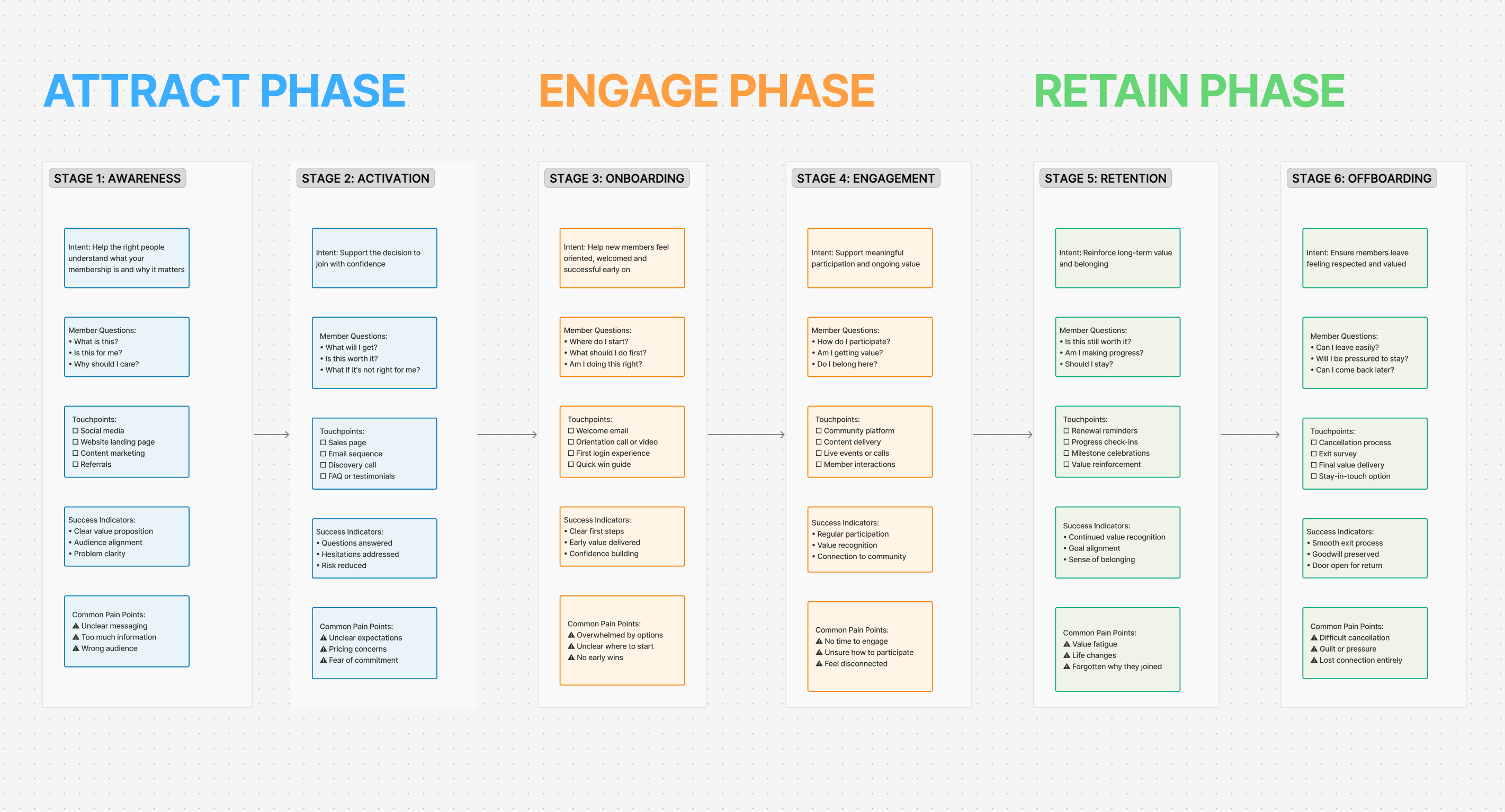
(For a larger image, open this up on FigJam)

Attract
Designing how the right people discover your membership and decide it is for them.
Stages: Awareness & Activation

Engage
Designing how members get value quickly when they join and feel motivated to participate.
Stages: Onboarding & Engagement

Retain
Designing how members continue to see value over time and leave on good terms if they choose to exit.
Stages: Retention & Offboarding
The six stages of the member journey framework
Here are the six stages of the member journey framework and their roles.
Intent: Help the right people understand what your membership is and why it matters to them.
This stage focuses on clarity. Members should quickly grasp who the membership is for, what problem it helps with and what makes it different, without feeling overwhelmed or confused.
Intent: Support the decision to join with confidence.
This stage bridges interest and commitment. It addresses questions, hesitations, expectations, and perceived risk so that joining feels like a thoughtful right choice.
Intent: Help new members feel oriented, welcomed and successful early on.
Onboarding is about momentum. Members should know what to do first, where to start and how to get value quickly, without needing to figure everything out on their own.
Intent: Support meaningful participation and ongoing value.
This stage focuses on how members interact with content, community and each other. Engagement is designed, not assumed. The goal is to make participation feel natural, rewarding and aligned with members' goals.
Intent: Reinforce long-term value and belonging.
Retention is about helping members recognize continued value over time. This includes rhythm, reflection points, renewal moments and signals that staying is worthwhile and aligned with their goals.
Intent: Ensure members leave feeling respected and valued.
Offboarding is designed as a transition. A thoughtful exit experience preserves trust, opens the door for return, and strengthens long-term brand goodwill.
How the Membership Journey Framework works
When you use this framework, you will have a clear structure of designing and improving your membership experience.
By seeing how each stage of the member experience connects, you will be able to spot weak points quickly and focus on the changes that matter, instead of guessing or adding more noise.
The goal is to create a membership that feels valuable and easy to stay engaged with, both for your members and for you as the owner.
At the end, you will have a cohesive membership experience that keeps members coming back, not more content or tactics.
Do you want to see how the framework works in practice?
If you'd like to use the membership journey framework to self audit your membership, then I have something for you!
Get the free self-audit workbook to help you see what's working and opportunities for improvement.
Ready to transform your membership?
I use the member journey framework in my flagship offer, The Membership Design Intensive, which is a focused, done-with-you engagement where we design or redesign your entire member journey, from first discovery to retention.